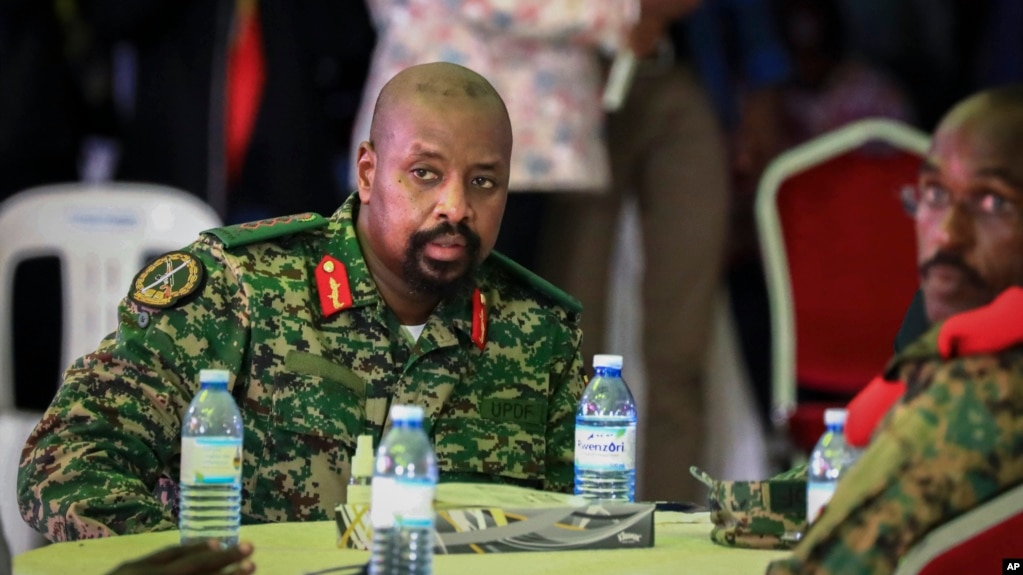
Uganda’s military chief, General Muhoozi Kainerugaba, has called on the US ambassador to apologize to President Yoweri Museveni or leave the country, raising tensions between the two nations. The ultimatum comes in the wake of the United States’ decision to sanction four Ugandan police officers for alleged human rights abuses. General Muhoozi, who is also President Museveni’s son, demanded an apology by Monday morning for what he termed as the ambassador’s “undiplomatic behavior.”
It remains unclear why Muhoozi issued the ultimatum, but his comments have sparked a debate over his authority to speak on diplomatic matters. Sewanyana Livingstone, director of the Foundation for Human Rights Initiative Uganda, criticized Muhoozi’s stance, stating that he has no legal power to declare the US envoy persona non grata. He emphasized that such declarations fall under the jurisdiction of Uganda’s Ministry of Foreign Affairs.
“Muhoozi needs to understand that Uganda is not him, and neither is he Uganda. Sanctions are the work of the US State Department, not its ambassadors,” said Livingstone. He further urged Ugandans to call Muhoozi to order, noting, “It’s time to draw a line.”
The controversy follows the US State Department’s announcement on Wednesday that four senior Ugandan police officers—Bob Kagarura, Alex Mwine, Elly Womanya, and Hamdani Twesigye—had been sanctioned for their involvement in “gross human rights violations.” The allegations include torture and other cruel treatment documented by civil society organizations, Ugandan courts, and independent media.
In response, Muhoozi took to social media to justify his comments, accusing the US of targeting his father’s government. “We have no problem with the USA... But we have evidence that they are working against the NRM government,” he wrote, referring to the National Resistance Movement, Museveni’s ruling party. He warned of severe consequences if foreign powers attempt to interfere in Uganda’s internal affairs, drawing comparisons to military resistance in Afghanistan.
Despite Muhoozi’s strong rhetoric, the US Embassy in Uganda has yet to issue an official response. A spokesperson noted that the embassy continues to work normally with Ugandan authorities. The State Department, however, reiterated its commitment to supporting justice for human rights victims worldwide and holding violators accountable through sanctions and visa restrictions.
The tension is part of a broader trend in US-Ugandan relations, which have been increasingly strained in recent years. While Museveni accepted US Ambassador William Popp’s credentials in 2023, confirming him as Washington’s representative to Uganda, there have been several instances of friction between the two nations, primarily over human rights and governance issues.
This latest diplomatic row has highlighted the complex dynamics of Uganda’s internal politics and the role of powerful military figures like Muhoozi. Observers note that although Uganda and the United States have maintained relatively stable diplomatic ties for over 60 years, the growing influence of military leaders on political affairs could complicate this relationship further.